Send the exact prompt or rubric your classroom shows and a custom OL 320 sample built to it comes back in 24 to 48 hours, the first one free. OL 320 is SNHU’s entrepreneurship course. It centers on applied graduate business, turning frameworks into decisions a real organization could act on. First, though, here is what the course actually grades, where points slip away, and how to lean on a sample honestly. Searches like "OL 320 module 4 assignment example", "OL320 sample paper", and "OL 320 module samples" land on this page.
What OL 320 is really about
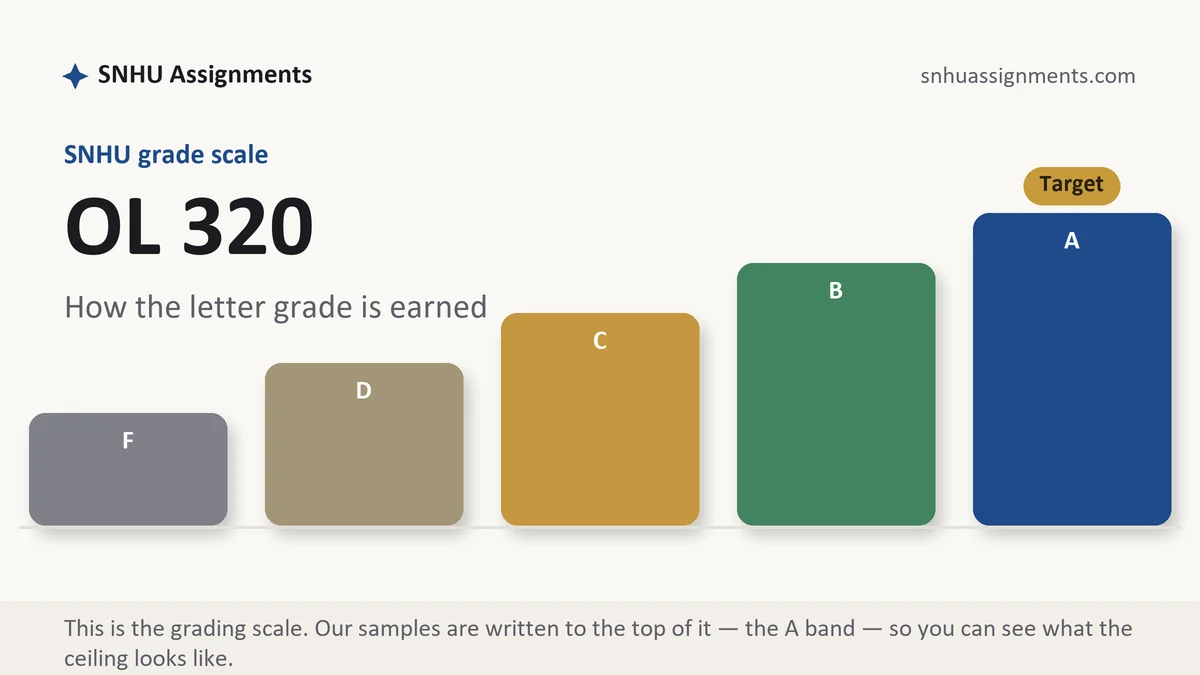
At this level, OL 320 is graded on application: the rubric wants you to take applied graduate business and use it on a real, specific situation, then defend your reasoning with current evidence. Recall alone does not clear the bar, which is why the work below rewards analysis over summary.
What OL 320’s assessments ask for
Across most versions of the course, the graded work tends to include:
- strategic or operational plans.
- applied papers and executive briefs.
- data-informed discussion posts.
- a business plan or proposal.
Where students lose points in OL 320
The recurring rubric-killers on work like this:
- a plan with no metrics to judge whether it worked.
- opinion where the rubric wants a named framework applied.
- recommendations with no real-company data behind them.
- staying theoretical instead of making a call and defending it.
- ignoring the financial or operational trade-offs the decision carries.
The OL 320 drawers
OL 320 Module 1 Opportunity Recognition Discussion example
A module 1 discussion on where business ideas come from: a physical therapist notices that her wheelchair-using clients struggle with ordinary pants, and asks whether a problem is the same as an opportunity. Full sample paper, annotated.
OL 320 Module 2 Final Project Milestone One Market Research example
Final project Milestone One: a market research paper for adaptive pants designed for wheelchair users, combining national data, published studies, a 64-person survey and a prototype fit test into a target market and size estimate. Full sample paper, annotated.
OL 320 Module 3 Final Project Milestone Two Presentation example
Final project Milestone Two: a five-slide narrated presentation of the adaptive pants idea, the problem, the solution, its value, what makes it different and what the founder is testing next, with a full narration script. Full sample paper, annotated.
OL 320 Module 4 Competitive Analysis Assignment example
A module 4 assignment analyzing competition and the value proposition for adaptive pants: four kinds of competitors including the tailor, a comparison table, industry forces and a positioning statement. Full sample paper, annotated.
OL 320 Module 5 Final Project Milestone Three example
Final project Milestone Three: the draft opportunity analysis plan for the adaptive apparel startup, sections one to three, the idea and its competition, the domestic and international market, and the founder and team. Full sample paper, annotated.
OL 320 Module 6 Startup Financing Assignment example
A module 6 assignment on financing a new venture: the adaptive apparel startup's $53,000 launch budget, five funding sources weighed on cost, control and fit, and a recommended mix of savings, rewards crowdfunding and a microloan. Full sample paper, annotated.
OL 320 Module 7 Final Opportunity Analysis Plan example
The final opportunity analysis plan for the adaptive apparel startup: the idea and its rivals, the market, the founder and team, and a phased path from preorder test to launch with dates, costs and go or stop points. Full sample paper, annotated.
OL 320 Module 8 Entrepreneurial Risk Discussion example
A closing discussion on risk and failure in entrepreneurship: what the adaptive apparel founder will do if the preorder campaign falls short, framed by affordable loss rather than all-or-nothing betting. Full sample paper, annotated.
Your classroom shows something different?
Deliverable names and counts shift between course versions. Send what you see and the desk matches it exactly.
Using a OL 320 sample the right way
Treat a OL 320 sample as a worked example, not a shortcut. Seeing how a strong response is organized, how it hits each rubric row, and how it handles evidence is the fastest way to learn the pattern, then you write your own and submit that. Samples are built to the instructions you send, revisions included, and how you use one is on you: stay inside SNHU’s academic-integrity policy.
OL 320 questions, answered
What kind of assignments does OL 320 have?
OL 320 typically runs to strategic or operational plans, applied papers and executive briefs, data-informed discussion posts, and a business plan or proposal. The exact mix depends on your course version, so send your rubric and the sample is written to match it.
How fast can I get a OL 320 sample, and what does it cost?
A custom OL 320 sample written to your own instructions arrives in 24 to 48 hours, and your first one is free. Revisions are included.
Will the sample match my OL 320 rubric?
Yes. It is written to the exact instructions and rubric you send, not pulled off a shelf. If your classroom shows different deliverables than the modules listed above, send what you see and the desk matches it.
Is it okay to use a OL 320 sample?
Use it the way it is meant to be used: as a model for structure, sourcing, and how a strong answer is built, then write and submit your own work. Always follow SNHU's academic-integrity policy.